Farmer Spotlight: Organizing Lays the Groundwork for Future Success
February 14, 2025The following article about Paul Sobocinski, a Niman Ranch hog farmer, was originally published by the Minnesota Farmers Union. Paul is one of Niman Ranch’s earliest hog farmers, first joining the network in 2003. He has been a leader in the movement to support independent family farms and a sustainable food system for decades. We are very proud that he and his wife Candy are a part of the Niman Ranch community. If you want to learn more, watch this video celebrating the Sobocinski’s 20-year anniversary with Niman Ranch.
By Janet Kubat Willette
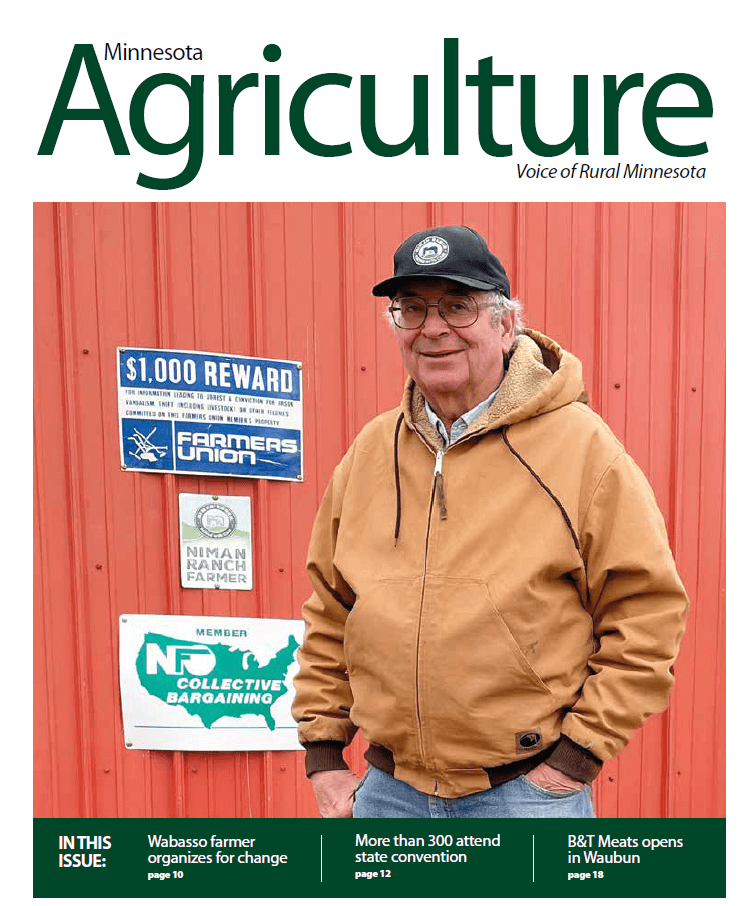 Paul Sobocinski began his organizing career while studying agricultural business management at Southwest Minnesota State University (SMSU) in the early 1970s. A recommendation was made to gut agricultural programming at the university. Sobocinski organized with the Minnesota Public Interest Research Group, a non-profit, non-partisan, student-led advocacy group to fight the recommendation. He led a petition drive that reached more than 500 farmers and successfully convinced the university to keep its agricultural programming, which continues today as part of the college’s School of Agriculture, Culinology and Hospitality Management.
His belief in organizing was instilled in him by his parents. His father grew up in New York and witnessed the intimidation and violence of strike breakers before serving in World War II. His mother worked as a Red Cross social worker during the war. They met during the war, married and settled in her hometown of Sleepy Eye. Together, they farmed and raised seven children. His father was active in the formation of the National Farmers Organization (NFO), which was founded in 1955 by farmers frustrated by the low prices they received for their farm products. Today, NFO combines production from farmers and negotiates prices from buyers utilizing collective bargaining strength. Sobocinski witnessed courage and a ‘can-do’ attitude in the strength of numbers, and it was there that the passion of organizing began for him.
When he started farming in 1977, Sobocinski joined NFO for its collective bargaining services and Farmers Union to work on agricultural policy. He raised hogs farrow-to-finish, starting with 30 gilts and building his operation to where he was marketing 1,000 pigs a year to Niman Ranch.
In the 1980s, Sobocinski was one of the rural leaders who helped organize Minnesota Groundswell in southwestern Minnesota. Groundswell brought together people from a variety of organizations to support farmers who were struggling to keep their farms. He built relationships with people on all sides, finding people who were willing to work together.
“Leadership is about bringing the best out of people, not the worst; it’s not about their fears, but their hopes,” Sobocinski said.
Agriculture was booming in the 1970s, but in the 1980s, the bottom fell out. Interest rates jumped from 9 percent to 21 percent. The price of farmland dropped by half. Farmers who had leveraged one farm to buy another in the boom times were unable to make their payments. Some bankers had encouraged farmers to take out loans, basing the loan on collateral values, not on what the land earned. When the foreclosures started, it was a domino effect. An estimated 300,000 farmers defaulted on their loans and more banks failed in 1985 than in any year since the 1930s, according to one historical account.
Organizing was difficult in 1983 and 1984, Sobocinski said, with 30 to 40 people showing up at meetings. By 1985, 400 people were showing up, desperate for information to save their farms.
There were several people in southwestern Minnesota who played a pivotal role in helping farmers during the farm crisis. Lou Anne Kling of Granite Falls helped develop the Minnesota Farm Advocate Program. Anne Kanten, of Milan, worked with her husband, Chuck, to form the American Agricultural Movement. She fought bank foreclosures, organized tractorcades to Washington, D.C., and helped start the Farm Advocate Program. She also served as deputy state agriculture commissioner.
Sobocinski stood shoulder-to-shoulder with these and other farmers, leading a farm protest rally at the state Capitol in 1985 that brought more than 17,000 farmers to St. Paul. He was the foreclosure chair for Groundswell, supporting neighbors by listening to their concerns, pushing for a moratorium on farm foreclosures and connecting them with farm advocates who advised them of their rights.
“You build power by getting people to work together for a common cause that includes their self-interest. This involves more people in that power process,” he said.
When Gov. Rudy Perpich wouldn’t put a moratorium on farm foreclosures, farmers stood forcefully together and attempted to put their own moratorium in place. The Rev. Jesse Jackson joined them at a foreclosure sale in Glenwood.
“Good people have to stand together,” Sobocinski said. “Ethics means everything.”
They weren’t always successful at stopping auctions and replevins of farm machinery. Sometimes when the sheriff and deputies arrived with a replevin order, there were tense moments.
“We tried to bring calm to these situations but also show firm support for the farmer and his family,” Sobocinski said. “We told law enforcement and the press – who were following our organizing actions – that something was terribly wrong. A hard-working farm family who was producing food for our nation was being foreclosed upon. Federal and state policy makers needed to address real solutions for farm families in crisis.”
On one protest trip to the Capitol, COACT leaders cut out the farm foreclosure sale notices from the Agri News and Farm Shopper newspapers and pasted them together in a 100-foot roll that Rep. Chuck Brown, DFL-Appleton, rolled out across legislator’s desks while they were debating a motion for a moratorium on farm foreclosures. The Speaker of the House then pounded the gavel, and pandemonium broke out as he attempted to adjourn the House while Groundswell farmers unfurled a banner over the balcony of the House chamber’s viewing area that read, “you can’t kill hope with a vote.”
“The year 1985 was pivotal in getting farmers to stand together, protest, demand justice and get the attention of state and federal officials,” Sobocinksi said. “In 1986, we saw we needed to engage with state and federal lawmakers.”
That’s when Sobocinski and others worked with MFU lobbyist Julie Bleyhl to lobby for policy that helped struggling farmers, including a right of first refusal, farmer-lender mediation, support for a farm advocate program and an interest buydown program.
The election of 1986 also ushered in new progressive rural legislators. Jim Vickerman of Tracy, Ted Winter of Fulda, and Doug Peterson of Madison were all instrumental in passing progressive farm policy, Sobocinski said.
As the farm crisis faded, Sobocinski was appointed to the state’s Rural Finance Authority Board. He worked with other board members to move the board from the Department of Commerce to the Department of Agriculture. He also worked to start the Aggie Bond Program for beginning farmers.
He worked to secure funding for sustainable and organic research at the University of Minnesota and served on the U of M’s Alternative Livestock Task Force. He was involved in the state’s feedlot fights about 20 years ago, when dueling reports were released on the state of the state’s livestock industry.
Sobocinski was quoted in the Star Tribune in July 2004, saying the report commissioned by Gov. Tim Pawlenty is “asking the citizens of Minnesota to give up democracy so that we can move large-scale industrial agriculture forward in this state.” Instead, he called for the state to help independent family farms compete and develop local markets for their products.
He has continued to stay involved in state and federal farm policy, working to secure an extension of the state’s Farmer-Lender Mediation Program in 2020.
Also in 2020, he became involved in MFU’s meat processing work. He is a project manager for MFU’s Solving the Local Meat Processing Bottleneck Project. He and others interviewed independent butchers to see what they needed and produced a report outlining the challenges facing local locker plant owners. Sobocinski continues to work on recruiting people interested in meat processing and connecting them with butchers who need workers or may want to transition out of the business.
His goal is to build a local food network that creates more opportunities for small, independent farmers and businesses.
“We have to build our own system,” Sobocinski said. The system must not only create an opportunity for new people to enter agriculture, but also create a connection with local, healthy food.
Organizing isn’t quick work, he said, rather it’s laying the groundwork for long-term success.